National Conference President Farooq Abdullah has voiced his concern over the escalating violence in West Asia, urging all parties to prioritise dialogue and diplomacy to de-escalate tensions and protect civilian lives.
India has expressed serious concerns about the West Asia crisis and its potential impact on energy supplies and maritime stability, urging BRICS nations to find practical solutions to geopolitical challenges and unilateral sanctions.
Prime Minister Narendra Modi addressed Parliament on the West Asia crisis, advocating for dialogue and diplomacy, ensuring the safety of Indians in the region, and addressing concerns about fuel and food security.

Pakistan's Foreign Minister Ishaq Dar met with his counterparts from Egypt and Turkiye in Islamabad ahead of a quadrilateral summit, including Saudi Arabia, to discuss the ongoing conflict in West Asia and explore avenues for peace.

India's foreign secretary Vikram Misri on Thursday participated in a high-level meeting hosted by the United Kingdom on the evolving situation in West Asia, underlining concerns over maritime security, energy supply disruptions and the need for diplomatic de-escalation.

Iranian Foreign Minister Abbas Araghchi is in India for a BRICS foreign ministers' meeting, where discussions will focus on the escalating crisis in West Asia and its impact on global energy supply chains.

Amidst escalating tensions in West Asia, India voices strong concerns over the safety of its nationals and the potential disruption to energy supplies, urging dialogue and diplomacy for a swift resolution.

The BRICS foreign ministers' meeting in New Delhi concluded without a joint statement due to disagreements over the West Asia conflict, with Iran blaming the UAE for the lack of consensus. India, as the host, issued a chair's statement highlighting the differing views.

The Cabinet Committee on Security (CCS) has reviewed the evolving situation in West Asia, directing departments to assist Indian nationals affected by recent developments and emphasizing the need for dialogue and diplomacy.

Foreign Ministers from Pakistan, Saudi Arabia, Turkiye, and Egypt convened in Antalya to explore avenues for enhanced cooperation across various sectors of mutual interest, reaffirming their commitment to regional peace and stability.

The gems and jewellery industry anticipates challenging times following the government's decision to increase gold import duty to 15 per cent, a move that exporters warn could fuel the grey market and heighten smuggling risks.

The Indian embassy in Tehran has earlier stated that it is facilitating the safe movement of nationals who wish to leave Iran.

India has expressed strong concern over the targeting of commercial shipping in the Strait of Hormuz during the West Asia conflict, urging for the restoration of unimpeded navigation and global commerce.

The Iranian Foreign Ministry has stated that Tehran currently has no plans for a subsequent round of negotiations with the United States, according to the state media Tasnim news agency. This announcement comes as international mediators had hoped for a follow-up to the Islamabad talks before the looming ceasefire deadline.

Amidst the stalling of high-level peace talks between Tehran and Washington, Iran continues to endure severe digital isolation as the nationwide internet blackout reached its 44th day on Sunday.

External Affairs Minister S Jaishankar addressed the Rajya Sabha on India's position regarding the escalating conflict in West Asia, emphasising the need for peace, dialogue, and the safety of civilians, while also prioritising India's energy security and trade interests.

US President Donald Trump has indefinitely extended the ceasefire with Iran at the request of Pakistan, aiming to allow Tehran's leadership time to form a unified proposal to end the seven-week war.

Pakistan is actively engaged in diplomatic efforts to facilitate negotiations between the US and Iran, with hopes of hosting a second round of talks in Islamabad.

India and Canada solidify their partnership with a landmark uranium supply agreement and discussions to finalise a comprehensive economic partnership, signaling stronger ties and cooperation on key global issues.

Union Minister Kiren Rijiju criticises Congress leader Rahul Gandhi's parliamentary conduct, accusing him of being unduly influenced by advisors and questioning his casual attire in the House.

Saudi Arabia and the UAE are actively pushing Trump to take the war to its bitter finish and 'erase' Iran's presence in the geopolitics of the region. Simply put, the two most powerful Sunni Arab oligarchies are on the same page as Israel. Such interference increases the risk of a breakdown in dialogue between the US and Iran, points out Ambassador M K Bhadrakumar.

'India should understand that we are not going to make the same mistakes with India that we made with China 20 years ago.'

The big question is whether Trump is any longer in command of the situation. For all practical purposes, the war seems set to cascade as the US is preparing for a potential ground operation in Iran and threatens to destroy 'bridges next, then electric power plants', points out Ambassador M K Bhadrakumar.

India and Israel have elevated their relationship to a special strategic partnership, focusing on enhanced cooperation in trade, technology, and defense, while also addressing regional peace initiatives.

The 'rescue' operation occurred within kilometres of Iran's underground tunnel complex at Isfahan, assessed by the IAEA and US intelligence as holding a substantial portion of the country's 60 per cent enriched uranium stockpile. Retired senior US military officers have highlighted that the mission's footprint -- hundreds of special operators, multiple heavy-lift aircraft deep inside Iran -- appears outsized for recovering a single airman. Prem Panicker continues his must read blog on the Iran War.

For weeks, the war skirted the edge of catastrophe without tipping over. Missiles flew, there was much destruction, commanders were assassinated, cities across the Gulf and even in Israel struggled to absorb the shock. But one line held: Energy infrastructure, the arteries of the global economy, remained largely untouched. That is no longer true. Prem Panicker continues his must read daily blog on the Gulf War.

In a region increasingly shaped by competition and coercion, such collaboration strengthens security without confrontation, builds capacity without dependency and promotes order without domination, points out Dr Kumar.

'TTP has vowed to take revenge for the attacks that Pakistan is carrying out against Afghanistan.' 'To diminish this threat, Pakistan is hitting Afghanistan hard.'

Israel and the United States had a plan. Iran punched back. And now the Gulf is reeling, the world is beginning to feel the pain and, as on date, no one in Washington or Tel Aviv appears willing to admit that the punch has landed, notes Prem Panicker, continuing his must-read blog on the war in the Middle East.

India and France have elevated their relationship to a 'special global strategic partnership,' with increased cooperation in defense, trade, and technology. The leaders also inaugurated a helicopter assembly line in Karnataka.
China and Pakistan concluded their strategic dialogue, reiterating their opposition to unilateral actions in South Asia and discussing Kashmir, Afghanistan, and trilateral cooperation.

Following an examination and discussions held in the aftermath of the United States' decision to withdraw from dozens of international organisations, Israel's Minister of Foreign Affairs, Gideon Sa'ar, has decided that Jerusalem will immediately sever all contact with several United Nations agencies and international bodies, citing what the government described as persistent bias, politicisation and actions hostile to Israel.
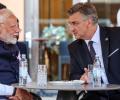
In his media statement following talks with his Croatian counterpart Andrej Plenkovic, Modi said both leaders agree that "terrorism is an enemy of humanity" and is inimical to forces that believe in democracy.
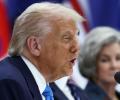
United States President Donald Trump on Wednesday said that the US is 'doing a trade deal with India' as the two sides continue to hold talks on the proposed trade pact.
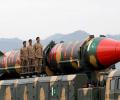
After Donald Trump became president of the United States, he unleashed economic weaponisation, upsetting the old world order, leading to much unrest. If that wasn't all, the threat of an imminent nuclear war was issued by the US, Russia, China, North Korea and Pakistan. In today's fractious times, Dr Paulos Mar Gregorios would have made a dent, notes His Holiness Baselios Marthoma Mathews III.

Prime Minister Narendra Modi emphasized the strong partnership between India and the UK, highlighting its importance for global stability and economic progress amidst global uncertainty. Discussions covered trade, defense cooperation, and geopolitical issues.

Whether it was in the company of superstars Rajinikanth and Kamal Haasan -- or, on rare occasions with both together, among others -- Saravanan's demeanour would stand out, observes N Sathiya Moorthy.
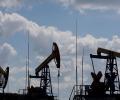
An influential US lawmaker claims his visit to India helped catalyze "early signals" that New Delhi may reduce its imports of Russian oil, a step he described as "meaningful" in weakening Moscow's ability to fund its war in Ukraine.
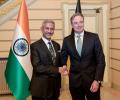
The era where nations thrived through rigid alignments is giving way to an age where the connective State defines power. For India, that era has arrived, points out Dr Nishakant Ojha.
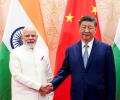
'What's currently underway is not a 'reset'.' 'What needs to be arrived at is a new balance.'
 © 2026 Rediff.com - Advertise with us - Disclaimer - Privacy Policy - Sitemap - Feedback - About us - Terms of use - Grievances